Events ·
What I learned from a successful Business Show in London
Two days of practical conversations reinforced why better AI starts with a business decision, not a technology demonstration.
By Harry Savigar
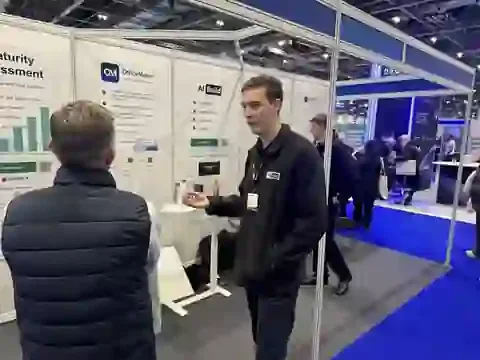
**The Business Show London 2026 was a success for us because of the conversations it started.** After two days at ExCeL London on 11–12 November, I came away with a clearer view of what businesses actually want from AI: not another demonstration for its own sake, but a practical way to understand a problem, decide what to do next and follow through.
Our AI Build Group stand brought together several things we have been building, including Asketta, OfficeMaker and our AI maturity assessment work. It was encouraging to see how naturally those subjects connected when we started with a visitor's real business challenge rather than with the technology.
What made the show successful for me?
For me, a productive exhibition is one where the conversations go beyond a quick look at a screen. I wanted to understand what people were trying to achieve, which information they already had, and where their existing processes were getting stuck. The most useful discussions were about decisions: what to measure, what to ask, who needs the results and what happens once the answers come back.
That is why I regard the show as a success. We had the opportunity to discuss genuine business needs and show how our tools could be applied, without pretending that one AI product is the answer to everything. I am not claiming a particular number of customers or sales from those conversations; the valuable part was the quality of the discussions and the opportunities to continue them.
Why do businesses need more than another form?
One theme I kept returning to was how much effort organisations spend gathering information and how little attention is sometimes paid to what happens afterwards. A form can collect answers, but somebody still needs to interpret them, chase missing detail, organise the evidence and turn it into a decision.
That is the problem we are working on with Asketta. I want a questionnaire to become a two-way conversation: ask the right question, follow up where necessary, stop when the required information is collected and give the person a useful, structured result. An AI interview is valuable only if it makes the process clearer and the outcome more actionable.
How does an AI maturity assessment help with planning?
Our AI maturity assessment was another useful starting point at the stand. I see an assessment as a planning and scoping exercise, not a badge or a score to display and forget. The real benefit comes from identifying the gaps, discussing priorities and deciding which improvements are realistic for that organisation.
The same principle applies to any structured questionnaire. Before choosing the tool, I ask what decision the answers are meant to support. If that question is not clear, the questionnaire probably needs more work.
What happens when the answers are collected?
Visitors could see OfficeMaker alongside Asketta on our stand. That matters because getting useful answers is only half the job. In the right configured workflow, structured data can support a reviewed briefing, report or document rather than leaving someone to copy and paste responses by hand.
I also think we should be careful about what the technology can prove. An AI-generated summary is not independent evidence that the answers are correct. Good questions, clear consent, appropriate data handling and human review still matter.
What will I do differently after the Business Show?
I want the conversation to continue after someone leaves the stand—or closes a webpage. That means giving people a relevant question to answer, showing how their response changes the next step and making it easy to carry on the discussion if they choose. I would rather have one genuinely helpful interaction than a page that simply tells everyone how clever the software is.
Turn this article into a conversation
I would love to know which challenge matters most to you after the show. Choose your priority, receive a practical next step, and tell me what you would like me to explore next. I only store answers with your consent; contact details are optional.
Participation is optional. Submitting answers requires your consent; individual answers are not public. Learn how Asketta works on websites.
If we met at The Business Show, thank you for taking the time to talk. I would be pleased to pick up where we left off. And if you were not there, I would still welcome a conversation about the questionnaire, assessment or reporting process you are trying to improve. You can explore [Asketta](https://asketta.ai), see [how it works](https://asketta.ai/how-it-works), or learn about [AI maturity assessments](https://asketta.ai/assessments/ai-maturity).
*Harry Savigar*
Frequently asked questions
- Where was The Business Show London 2026 held?
- At ExCeL London on 11–12 November 2026, where AI Build Group had stand B501.
- What did I learn from the show?
- People wanted practical advice on the decisions, processes and reports AI could support, rather than demonstrations without a clear next step.
- How can an AI maturity assessment help?
- It supports planning and scoping: identifying current capability, gaps, priorities and realistic implementation steps.